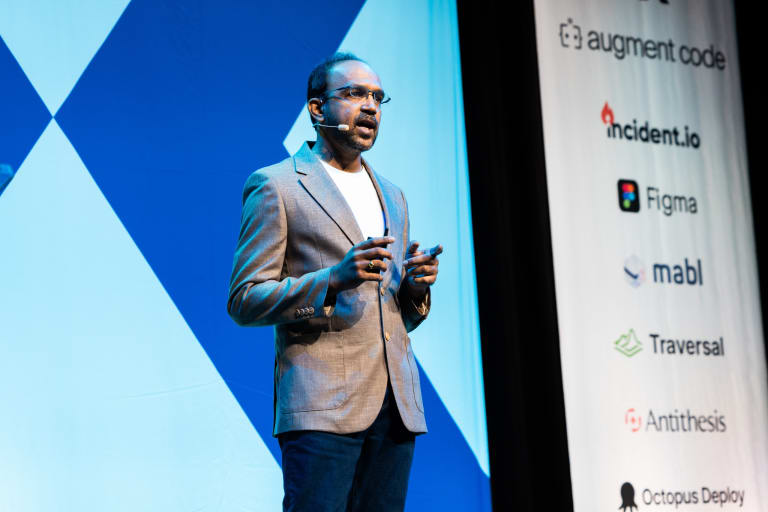
Register or log in to access this video
New York • September 8 & 9, 2027
Loved LDX3 New York? Pre-sale tickets for 2027 are now available.
Autonomous AI agents are transforming software delivery from scripted automation to systems that make decisions without human approval.
Your agent decides which tests to run, whether to approve deployments, and how to prioritize risks. But when it gets it wrong, who’s accountable?
The public record already shows how this goes: a coding agent deleting a production database during an explicit code freeze, an agent acting on fabricated success signals until user data was gone, stolen agent credentials exposing data at 700+ organizations. In every case, the postmortem question “who approved this?” had no answer — and in none of them was the failure a model problem.
Traditional “human-in-the-loop” governance doesn’t scale — you can’t manually review every agent decision when you’re processing thousands daily.
This session walks through an engineering framework for accountable autonomy: a three-tier trust model that categorizes decisions by blast radius (impact and reversibility), an autonomy budget that meters agent trust with SLOs and revokes it automatically when behavior degrades, and circuit breakers that freeze an agent before a bad pattern becomes an incident.
Engineering leaders will see how to design systems where agents operate autonomously for low-risk decisions (reading incidents, analyzing logs) while requiring human approval for high-impact changes (production deployments, external communications, user data access) — and how trust moves between those modes automatically, based on measured behavior.
You’ll see a demonstration of an open-source reference implementation that runs on a laptop, observability patterns using OpenTelemetry that make agent actions transparent enough to audit, and the exact language that satisfies legal and security stakeholders without slowing engineering.
This isn’t about saying “no” to agentic AI — it’s about building the guardrails that let your team confidently say “yes.”
The organizations that win with autonomous AI won’t be the ones with the most capable agents; they’ll be th e ones with the best governance architecture.
You’ll leave with a decision matrix for automation versus human approval, a blueprint for metering autonomy with SLOs, and communication frameworks for introducing agentic systems to skeptical stakeholders.
The accountability gap is solvable. This is how you engineer trust at scale.
Key takeaways:
- Three-tier trust model: A decision matrix categorizing which agent actions can be fully automated (low blast radius, reversible) versus always requiring human approval (high impact, irreversible) — crossed with the agent’s current trust level
- The autonomy budget: SLOs and error budgets applied to agent trust — autonomy that is earned through measured behavior, revoked automatically on breach, and backstopped by circuit breakers
- Observability architecture: Concrete patterns using OpenTelemetry semantic conventions to build audit trails that answer “who authorized this?” — the question legal teams actually ask
- Stakeholder communication framework: The exact sentences for explaining agentic governance to legal, security, and executive stakeholders who demand accountability without understanding the technology