
You have 1 article left to read this month before you need to register a free LeadDev.com account.
Estimated reading time: 3 minutes
Key takeaways:
- Manual code review has a shelf life. JetBrains CEO Kirill Skrygan expects humans to stop reviewing code line by line within two years.
- Your oversight shifts to guardrails. Set the architectural rules agents must follow, and get your engineers’ knowledge of the codebase out of their heads and written down.
- Split agent work to keep accountability and give each agent a defined responsibility, with checks between stages, so you can pinpoint where a failure happened.
According to a survey of 500 engineering leaders conducted by LeadDev and Harness, 57% still require human review of every line of AI-generated code. Some 29% report spending more time reviewing code than they did before AI-coding tools arrived.
However, the days of software engineers manually reviewing code written by their colleagues could be numbered. In fact, Kirill Skrygan, CEO of JetBrains, reckons that soon, most engineering teams won’t be reviewing code manually at all.
Your inbox, upgraded.
Receive weekly engineering insights to level up your leadership approach.
“I think in two years you would hardly find an engineering org where humans will still be doing manual code review,” he says. The shift is driven by AI-coding agents, which are upending the established order. Developers who previously might have spent days writing a feature can now ask an agent to do it in minutes.
As some of the social media scuttlebutt around the recent Microsoft Exchange Online outage shows, there are some who worry that AI-generated code still needs plenty of checking.
To tackle that, Skrygan believes engineering teams need to rethink how they work. “It’s not code generation anymore – it’s now code review,” he says.
Software factories replace manual code review
Skrygan foresees a future in which engineering teams operate what he calls software factories – where pipelines of AI agents that handle different aspects of software development operate.
JetBrains has already implemented a similar pipeline within different teams, and Skrygan reckons routine code review will increasingly be carried out by AI agents, powered by different models to avoid groupthink while cross-checking work.
That might help avoid some of the most catastrophic errors, but it still poses a key question about accountability: if humans aren’t checking the code, how can they be sure that what the agents produce is safe to ship?
Skrygan suggests human oversight will shift from individual lines of code toward what he calls architectural guardrails, or invariants: the rules that govern how software should work, which agents will have to follow precisely.
An engineering manager could specify that certain components must remain stateless in a project, for instance, but even that comes with its own hitches. “What cannot be done automatically is keeping these invariants and guardrails,” Skrygan says.
Who’s responsible?
Such a shift would require engineering managers to change how they oversee their teams. It also requires experienced engineers to be willing to document what they know about their codebase for posterity. “Offload domain knowledge. This is my advice,” says Skrygan.
Getting that knowledge out of human brains and into a machine-readable format is a challenge JetBrains has encountered internally. It doesn’t always work, even by Skrygan’s own admission: in one instance, an autonomous agent received contradictory instructions from two employees and said that it needed the humans to resolve their differences before it could proceed.
However, research by JetBrains and Lund University suggests that traditional code review tools struggle with AI-generated changes because developers lack the contextual information they’d ordinarily have about a human colleague’s work – meaning some hitches might still get through.
The researchers behind that paper argue for review tools that help developers identify which parts of AI-generated code need a closer look.
More like this
Managing change
There’s another issue for managers: identifying responsibility when something goes wrong. Agents can very easily become a black box, with developers struggling to understand precisely where a mistake occurred – which might be fine for an informal project, but isn’t a useful way to run a system that sits at the heart of an organization.
Skrygan’s answer is to split up work between different agents, with clearly defined responsibilities and checks between stages. Then if something goes wrong, it’s easier to pinpoint which part is to blame. “If the cost of error is very high for your system,” he explains, “then you would like to dig in deeper and understand where exactly it’s broken.”
New York • September 8 & 9, 2027
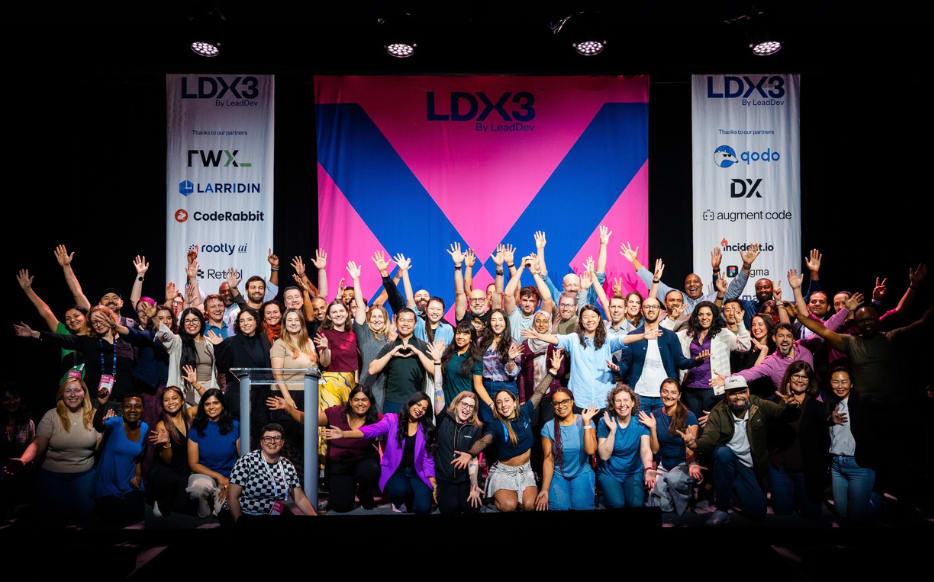
Loved LDX3 New York? Pre-sale tickets for 2027 are now available.
Skrygan’s prediction that manual code review will disappear within two years remains an ambitious one. However, whether it happens that quickly or not, engineering managers are already having to work out how much responsibility they’re comfortable handing over to machines.
Ultimately, the human remains at the core of any engineering effort. “The role of the human is to be a cross-domain knowledge owner,” says Skrygan, “who can guide different agents or meta-agents across different domains.”


